

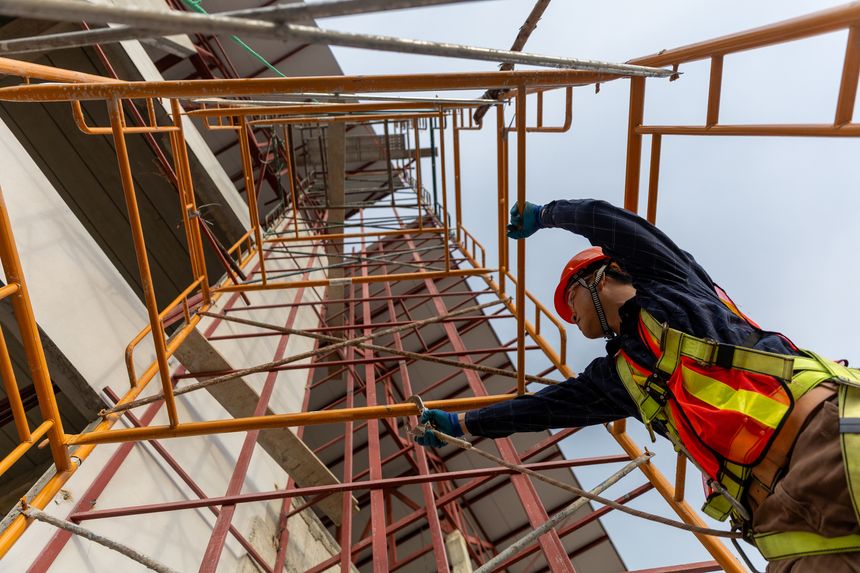

In Tobon v. Turner Constr. Co. (2026), decided in August, the Appellate Division, First Department, affirmed the lower court's grant of partial summary judgment to plaintiff on his Labor Law § 240(1) claim. The Court held that even though the plaintiff was "surfing" on the scaffold at the time of the accident, his injuries were nonetheless caused by a violation of § 240(1), and evidence of his own comparative fault—including his decision to ride the moving scaffold—did not defeat his claim.
"Scaffold surfing" is a term used to describe a worker remaining on the elevated platform of a scaffold while the scaffold is being moved. It is generally considered to be inappropriate construction-site behavior and is widely frowned upon.
The facts of Tobon are therefore notable. The plaintiff directed his coworkers to move the scaffold while he remained on it. While the scaffold was being moved, it tipped over and the plaintiff fell, allegedly sustaining injuries. Plaintiff moved for partial summary judgment on his § 240(1) claim, and the motion was granted.
Defendants appealed, arguing, among other things, that the plaintiff's decision to ride the moving scaffold constituted misuse and rendered him the sole proximate cause of his accident. The First Department rejected that argument and affirmed. The Court noted that nothing in the record suggested that the process of moving the scaffold while the plaintiff remained on it was "the product of plaintiff's independent devise." The Court further reiterated that comparative negligence is not a defense to a § 240(1) claim. The general contractor's instruction not to "ride or surf" the scaffold also could not form the basis of a recalcitrant-worker defense.
The takeaway remains the same. In § 240(1) cases, the sole proximate cause defense remains available, but elusive. Successfully invoking the defense generally requires evidence that an injured worker had an adequate and readily available safety device, knew that he was expected to use it, and chose not to do so for no good reason.
Tobon illustrates just how important that distinction can be. Riding a moving scaffold may appear, in ordinary negligence terms, to be compelling evidence of a worker's own responsibility for an accident. Under § 240(1), however, evidence of unsafe conduct is not necessarily evidence that the worker was the sole proximate cause of the accident. Here, even "surfing" the scaffold was insufficient to defeat the plaintiff's entitlement to summary judgment.
/Passle/63eb9d4af636ea0fb4cba53a/MediaLibrary/Images/2026-10-12-19-37-13-157-6acd36e95011758bb0bf63e5.png)
/Passle/63eb9d4af636ea0fb4cba53a/SearchServiceImages/2026-10-12-20-01-12-161-6acd3c886b66afb021ed02b8.jpg)
/Passle/63eb9d4af636ea0fb4cba53a/SearchServiceImages/2026-10-07-18-12-34-587-6ac68b92fb51287ac2258e9a.jpg)