

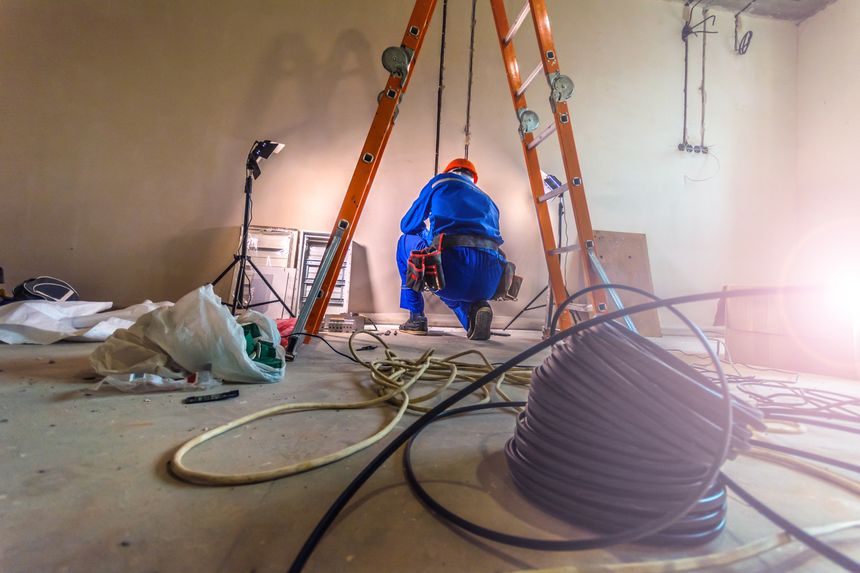

In Hearns v. Blended Family LLC (2026), the plaintiff was a telecommunications field technician installing wireless internet service at a mixed-use building. According to the plaintiff, the installation required a "long run" of cable through a drop ceiling and into the building's telecommunications equipment room. He testified that he drilled two holes through the walls to route the cable. While pulling the cable from a ladder in the basement hallway, the ladder allegedly shifted and fell, causing his accident.
The First Department nevertheless affirmed dismissal of the Labor Law § 240(1) claim. The key issue was not simply that the plaintiff fell from a ladder—it was whether the work he was performing qualified as a protected activity under the statute. The court reiterated that an "alteration" must go beyond simple or routine work and effect a significant physical change to the configuration or composition of the building or significantly change how an important building component functions. Plaintiff's "self-described action of drilling two holes in order to run the cable wire" did not meet that standard.
That distinction has practical significance in defending § 240(1) claims arising from telecommunications and similar installation work. The use of a ladder, drilling into a wall, running wire through a ceiling, or otherwise making some physical modification to a building does not by itself establish that the worker was engaged in a statutory "alteration." The analysis remains focused on the nature and extent of the physical change produced by the work.
The decision also contains a useful risk-transfer holding. The building owner received conditional contractual indemnification from the commercial tenant, even though questions of fact remained concerning whether the owner had supplied the ladder involved in the accident. The First Department held that the indemnification provision was not void under General Obligations Law § 5-321 where sophisticated parties negotiating at arm's length had allocated third-party liability between themselves through insurance.
Practical takeaway: In defending a Labor Law § 240(1) claim involving installation or telecommunications work, the fact that the accident involved a ladder should not end the analysis. Discovery should establish and develop precisely what the worker was installing, what physical changes were made to the premises, and whether those changes were sufficiently significant to constitute an "alteration." At the same time, contractual indemnity and insurance provisions should be analyzed independently for potential risk transfer.
/Passle/63eb9d4af636ea0fb4cba53a/MediaLibrary/Images/2026-10-12-19-37-13-157-6acd36e95011758bb0bf63e5.png)
/Passle/63eb9d4af636ea0fb4cba53a/SearchServiceImages/2026-10-12-20-01-12-161-6acd3c886b66afb021ed02b8.jpg)
/Passle/63eb9d4af636ea0fb4cba53a/SearchServiceImages/2026-10-07-18-12-34-587-6ac68b92fb51287ac2258e9a.jpg)